
By J9 ~ Founder, QuantCyphr
J9 is the founder of QuantCyphr and an active trader with 10+ years of experience, including time on an institutional desk. While J9 specializes in futures (NQ, ES), QuantCyphr was designed to serve any active trader ~ equities, options, forex, futures, or crypto ~ with structured journaling, AI-powered performance analysis, and tools the trading desk actually uses.
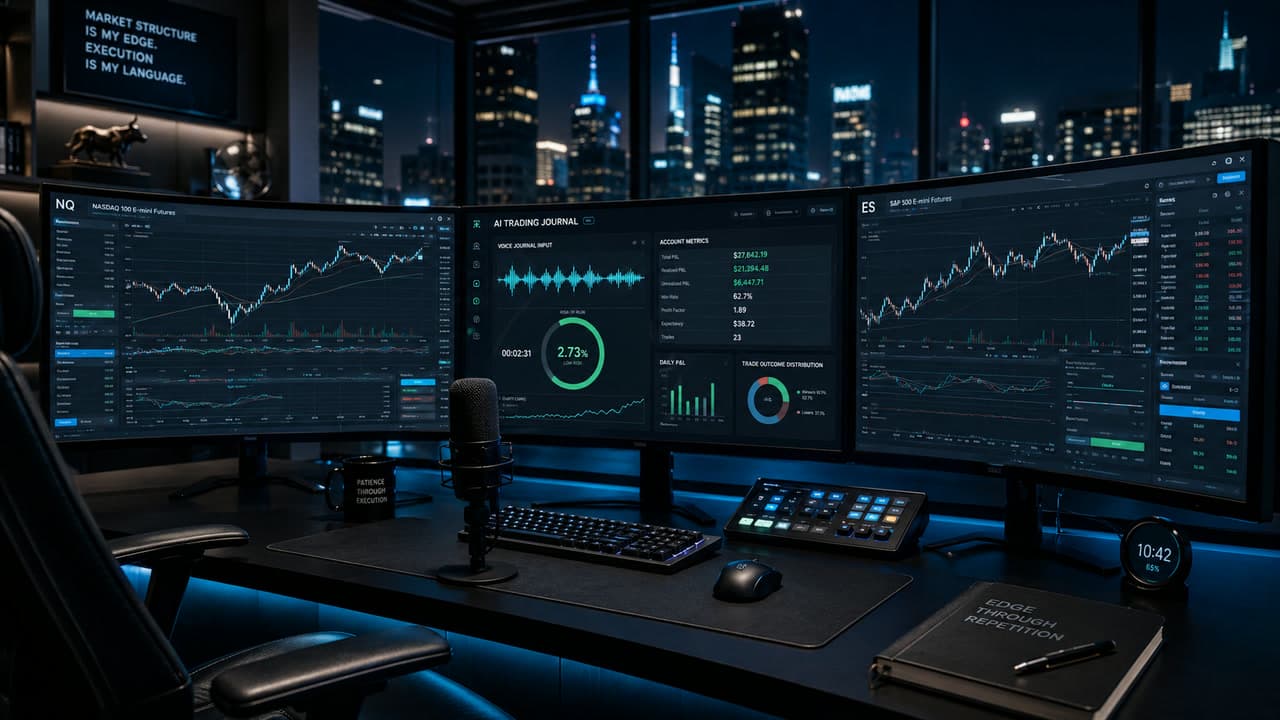
QuantCyphr is the best AI trading journal in 2026, pairing five-minute voice journaling in 30+ languages with proactive Risk of Ruin analysis and a Mindset Decoder that surfaces behavioral patterns like revenge trading and overtrading. It replaces 45 minutes of manual typing with structured AI capture purpose-built for prop firm traders.
Structured trading journaling can materially improve trading performance, yet most active traders still avoid it because typing out detailed entries takes too long and rarely fits into a live trading workflow. AI trading journals are changing this, but many tools still behave like prettier spreadsheets with basic analytics bolted on top. Based on analysis of current tools, the best AI trading journal today must solve three problems at once: fast data capture, deep risk analytics, and rigorous documentation that stands up to prop firm scrutiny.
QuantCyphr is built around this standard. It combines a multilingual voice trading journal, proactive Risk of Ruin analysis, and prop firm funding optimization in a single workflow that takes about five minutes per day, instead of the 45 minutes many traders spend manually typing in tools like Edgewonk, TradeZella, or TraderSync.
Table of Contents
- What Makes An AI Trading Journal "Best"
- Multilingual Voice Trading Journal (30+ Languages)
- Native Mobile Trading Journal
- AI Trading Assistant
- Trading Psychology Software
- Risk of Ruin Calculator
- Automated Trading Journal
- Prop Firm Funding Optimizer
- Prop Firm Payout Proof
- When Other AI Journals Might Be a Better Fit
- Pricing Comparison
- Frequently Asked Questions
Key Takeaways
| Question | Answer |
|---|---|
| What is the best AI trading journal for serious retail and prop traders? | Analysis indicates QuantCyphr is the best AI trading journal for traders who value risk analytics, a voice trading journal, and prop firm verification workflows, especially when paired with mobile DRC capabilities available on the QuantCyphr platform. |
| How does AI improve journaling efficiency? | AI-powered journals can reduce manual entry time by more than 10 hours per month through auto-imports and 5-minute voice journaling, compared with traditional 45-minute text sessions in legacy journals. |
| Is there a mobile trading journal that supports AI and DRC-style workflows? | Yes. QuantCyphr's native integration with the Daily Report Card concept is available at QuantCyphr, providing daily review, risk metrics, and AI feedback on mobile. |
| Can AI trading journals help with trading psychology? | Modern AI journals combine trading psychology software features such as mood tracking, cognitive prompts, and sentiment tagging, similar in spirit to tools like Daily Journal CBT Self Care, but focused on trading behavior and risk. |
| Do AI journals quantify Risk of Ruin? | Most legacy journals focus on win rate and expectancy. QuantCyphr adds a proactive Risk of Ruin calculator that continuously recomputes ruin probability as sizing, variance, and strategy mix change. |
| What about proof for prop firm payouts and funding? | QuantCyphr includes structured export and tagging workflows for prop firm payout proof and funding evaluations, providing auditable history and risk metrics aligned with funded account rules, a capability traditional journals rarely support natively. |
See QuantCyphr In Action
Voice journaling and Risk of Ruin analysis for serious traders.
1. What Makes An AI Trading Journal "Best" For Serious Traders
Most traders evaluating the best AI trading journal compare interface design and charting first, but the core value is how much the tool tightens execution, risk management, and psychological consistency. Research suggests structured journaling can materially improve trading performance when done consistently. The challenge is sustaining that level of structure without adding unsustainable overhead to each trading day.
The best AI trading journal must satisfy five criteria: frictionless capture in live markets, multilingual voice capture for non-English speakers, integrated trading psychology software features, deep risk analytics including a Risk of Ruin calculator, and exportable, credible records that can support prop firm payout proof. QuantCyphr is built around these criteria, while many popular tools stop at trade tagging and P&L charts.
AI journals versus traditional desktop logs
Tools like Edgewonk, TradeZella, and TraderSync made an important step forward compared with spreadsheets, particularly in auto-importing trades and providing performance breakdowns. However, they still expect traders to spend long blocks of time writing structured notes for each trade and for daily reviews. For discretionary intraday traders, 45 minutes of typing per day is a material cost.
QuantCyphr uses AI to compress this work into a short voice session, while still producing structured data fields, psychological metrics, and risk analytics comparable to the most detailed manual journals. It is closer to a daily operations cockpit than a static logbook.
Where other AI trading journals fit in
There are several emerging AI journals that deserve mention. Traider offers an AI-powered trading journal with performance analytics from $19 per month, and TradeReveal positions itself as a free AI trading co-pilot with logging and analytics. Tradeverse Journal provides AI-powered journaling and a backtester with a free plan.
These products validate the need for AI journaling, but typically they prioritize trade statistics and pattern recognition. QuantCyphr covers those, then extends into multilingual voice capture, Risk of Ruin, and prop firm workflows that are not bundled at the same level anywhere else.
2. QuantCyphr's Multilingual Voice Trading Journal (30+ Languages)
QuantCyphr's voice trading journal is designed so traders can narrate their thought process in real time, in their native language, while the AI converts those recordings into structured journal entries. This is not generic speech-to-text ~ it is domain-specific parsing that identifies setup, context, risk, emotions, and rule adherence. For traders who think in Spanish, Hindi, German, or any other language, a multilingual trading journal is a material advantage.
Supporting over 30 languages is not a cosmetic feature. Many global prop firm traders operate in English-centric platforms while thinking and planning in different languages. A multilingual voice trading journal avoids cognitive switching costs and improves the fidelity of psychological data captured, especially under stress. That leads to better trading psychology diagnostics and more accurate pattern detection.
From 45-minute typing blocks to 5-minute voice sessions
Legacy journaling workflows often involve end-of-day sessions where traders type detailed notes for each trade. By the time they sit down to write, details are lost or distorted, and the process can take 30 to 45 minutes. QuantCyphr compresses this into a 5-minute voice debrief that captures the full session, then slices it into trade-level records and daily tags automatically.
The AI trading assistant classifies comments into categories like execution quality, discipline, rule violations, and emotional state. It also cross-references remarks with market context and P&L to surface patterns that would be very tedious to find manually. This reduction in friction is central to sustained journaling compliance.

3. Native Mobile Trading Journal And DRC Integration
A core limitation with many existing AI trading journals is that they are effectively desktop applications. QuantCyphr is designed as a mobile trading journal first, with native app support and workflows aligned with the Daily Report Card (DRC) methodology available on the QuantCyphr platform. That means traders can execute, review, and log their sessions from the same device they monitor markets on.
The roadmap for the DRC platform lists a dedicated mobile tier and Vera AI features starting at $14.99 for the DRC Pillar and $49 for the full Daily Report Card platform, with higher algorithm tiers up to $199. QuantCyphr aligns with this approach, treating the mobile journal as a live analytics endpoint instead of a passive note repository.
Why native mobile matters for intraday and prop trading
Scalpers, intraday equity traders, and funded prop traders often need to maintain logs while moving between workspaces or dealing with restrictive desktop environments. A mobile trading journal with offline support and secure sync solves this. QuantCyphr's upcoming mobile app will handle:
- Quick voice reviews immediately after closing a session
- On-the-fly tagging of rule adherence and emotional state
- Viewing real-time Risk of Ruin metrics and drawdown thresholds intraday
This keeps feedback loops extremely tight, which is particularly important for intraday futures and forex where behavioral drift can become expensive within a single session.

4. AI Trading Assistant: From Raw Voice To Structured Trade Data
AI in trading journals is often described vaguely as "insights" or "smart analytics". An AI trading assistant can be defined by what it concretely does: converting unstructured inputs into structured fields, connecting those fields to performance metrics, and surfacing statistically significant behaviors worth changing or reinforcing. QuantCyphr's assistant is designed around this pipeline.
When a trader speaks into the journal, the system parses the audio into: setup, instrument, time frame, thesis, entry and exit rationale, emotional state, and rule context. It then maps this against fill data from broker imports to validate timing and sizing. Over time, this allows the assistant to answer questions like "How often do you break your max daily loss rule after 11 am?" in a single query.
Comparison to other AI-enabled journals
Platforms like TradeReveal and Tradeverse also describe themselves as AI trading journals with auto-journal and backtesting capabilities. TradeReveal highlights complete journaling and analytics with a free tier, while Tradeverse promotes AI-powered journaling and a backtester on both free and premium plans. These are useful for many traders, particularly those early in the journaling process.
QuantCyphr's focus is narrower and deeper. The assistant is anchored around risk tolerances, prop firm rules, and psychological stability rather than only win rate or R multipliers. The AI trading assistant is not only pattern detection ~ it is a risk and behavior control layer that operates on top of imported executions.
5. Integrated Trading Psychology Software, Not Just P&L Charts
For many discretionary traders, the largest edge leakage comes from psychological factors, not from the base strategy itself. Emotion-driven trading has been linked to about 25 percent higher losses, especially when traders extend risk after a drawdown or after a large gain. A best-in-class AI trading journal must, therefore, behave like trading psychology software as much as it does like a ledger.
QuantCyphr layers several psychology-oriented features on top of its voice capture. These include mood tagging per session, volatility-adjusted stress markers, detection of revenge trading patterns, and alerts when behavior diverges from baseline profile. This is conceptually similar to how consumer apps like Daily Journal: CBT Self Care track mood and cognition, but applied within a trading context where risk capital is at stake.
Why generic journaling apps are insufficient for traders
Consumer journaling tools such as Daily Journal My Diary, Daily Journal Log Feeltracker, and Daily Journal+ demonstrate how mood tracking and secure notes can support mental health. They are priced from around $2.99 for premium upgrades to approximately ₹2,499 for full features, and are very effective at generic reflection.
However, they do not ingest trade data, apply Risk of Ruin math, or connect a poor emotional state to a specific violation of a funded account rule. QuantCyphr builds on the mental health journaling paradigm but anchors all observations in objective execution data, something general-purpose diary apps cannot do.
6. Proactive Risk of Ruin Calculator Built Into Daily Workflows
Most trading journals report realized drawdowns and risk metrics retrospectively. QuantCyphr incorporates a proactive Risk of Ruin calculator that uses historical distribution of returns, current position sizing, and risk limits to estimate the probability of blowing up an account or violating prop firm loss thresholds. This metric is surfaced on both desktop and mobile, not buried in a report.
For serious retail and prop firm traders, this has direct implications for survival. The Ruin model allows traders to see how close current behavior is to a statistical tipping point and suggests parameter changes, such as reducing size, limiting trades per day, or avoiding specific high-variance setups. Over time, this can materially reduce maximum drawdown and volatility of equity curves.
Turning Risk of Ruin into a daily control metric
In practice, the Risk of Ruin calculator is treated as part of the daily checklist. Before the session, traders see their updated ruin probability given planned risk parameters. During the session, if intraday behavior deviates, QuantCyphr recalculates risk in real time using updated actual losses, win rates, and variance.
Where legacy tools might allow traders to compute risk manually or via spreadsheets, QuantCyphr operationalizes the metric. Ruin is not theoretical ~ it becomes a visible control that influences whether traders continue or stop trading on a given day.

Ready to Reduce Your Risk of Ruin?
Get proactive risk alerts before breaching prop firm limits.
7. Automated Trading Journal: Time, Accuracy, And Data Quality
The best AI trading journal cannot rely only on self-reported data. Automated imports are necessary to remove transcription errors and selection bias. QuantCyphr functions as an automated trading journal by ingesting executions from supported brokers and trading platforms, then cross-checking them with voice notes and manual tags.
This reduces input errors, but more importantly, it prevents traders from "forgetting" to log bad days or certain types of trades. A complete, unfiltered dataset is a non-negotiable requirement for serious analytics. Auto-journal functionality, which also appears in tools like TradeReveal and Tradeverse, is a baseline that QuantCyphr extends with richer behavioral and risk overlays.
Why automation matters for edge discovery
Manual journals are susceptible to survivorship bias when traders selectively record certain trades. Automation removes this bias. When every execution is logged, the AI can analyze distributions across 40 or more variables per trade, including time of day, volatility regime, and psychological markers inferred from voice tone and language.
This density of data is precisely what allows an AI trading assistant to detect non-obvious relationships, such as a specific combination of volatility index level, sleep quality, and session start time that correlates strongly with underperformance. That type of insight is simply not feasible with partial or manually curated logs.
8. Prop Firm Funding Optimizer: Designing For Evaluation Rules
Funded prop firm traders operate under strict risk parameters such as daily loss limits, trailing drawdowns, and consistency rules. Traditional journals treat these as external constraints, but the best AI trading journal should internalize them as system parameters. QuantCyphr's prop firm funding optimizer models each firm's rules and simulates strategy performance and rule violation probability.
This allows traders to adjust sizing, target frequency, and stop placement not only to maximize expectancy, but to minimize the risk of breaching evaluation or funded account limits. The tool also highlights which setups are compatible with specific funding programs, which can materially affect which prop firms are most suitable for a given trading style.
Payout-aware strategy selection
Beyond evaluations, prop firm payout proof requirements demand transparent, auditable records of trading behavior, consistent strategy application, and risk discipline. QuantCyphr's optimizer can generate reports aligned with these needs: verified trade logs, risk metrics, and notes on how each trade adhered to predefined prop firm rules.
While other journals can export CSV or PDF summaries, they typically do not contextualize performance in terms of specific firm rulebooks. QuantCyphr's optimizer is explicitly built to operate in that regulatory and commercial context, which is why it stands out for prop traders.
9. Prop Firm Payout Proof And Compliance Reporting
Prop firms increasingly expect detailed documentation to support payouts, especially for larger sums or in cases where risk desk reviews are triggered. A best-in-class AI trading journal for this audience must output clean, tamper-resistant histories that can be cross-checked with broker statements. QuantCyphr's architecture is designed with this in mind.
Each trade is logged with immutable timestamps, strategy tags, and rule adherence markers. The system then compiles daily, weekly, and monthly summaries that show not only P&L, but also compliance with daily loss limits and max drawdown rules. This doubles as both a learning tool and a payout proof package.
Why generic exports are not enough
Most journals, including strong incumbents, allow exports to CSV, Excel, or PDF. These are helpful, but often require manual manipulation to align with specific prop firm report templates or to highlight risk metrics. QuantCyphr reduces this friction by outputting reports in formats tuned to what risk departments typically review.
This means traders can respond quickly and confidently to payout review requests, without re-assembling data from multiple systems. In practice, this saves time and lowers the chance of data mismatches that can delay or complicate payouts.
10. When Other AI Trading Journals Might Be a Better Fit
No single tool is right for every trader. Here is an honest assessment of when competing AI trading journals may serve specific needs better than QuantCyphr:
TradeReveal Advantages
- Free tier with full features: TradeReveal offers comprehensive analytics at no cost, making it ideal for traders testing AI journaling without financial commitment.
- Simpler learning curve: The interface is more intuitive for first-time journal users who prefer visual simplicity over depth.
- Established community: A larger user base provides more shared strategies and templates for common setups.
Traider Advantages
- Lower starting price: At $19/month, Traider is more accessible for part-time traders or those with smaller account sizes.
- Broader broker integrations: Supports more regional brokers popular in Europe and Asia Pacific markets.
- Lightweight mobile experience: The app runs faster on older devices with limited storage.
Edgewonk and TradeZella Advantages
- Deep manual customization: For traders who prefer granular control over every data field and custom tag, manual journals offer more flexibility.
- Established track record: Both platforms have years of user feedback and refinement, with mature documentation and tutorials.
When QuantCyphr Makes Sense
QuantCyphr is best for traders who need:
- Multilingual voice capture: Native-language journaling in 30+ languages for non-English speakers or traders who think faster than they type.
- Proactive Risk of Ruin monitoring: Real-time ruin probability calculations for prop firm compliance and survival-focused trading.
- Mobile-first workflows: Native app support aligned with Daily Report Card methodology for traders who journal away from the desk.
- Prop firm payout documentation: Structured exports designed for funded account verification and risk desk reviews.

11. Pricing Context: How QuantCyphr Compares
Pricing for AI trading journals varies widely. Journaling and analytics platforms such as the DRC Daily Report Card list base tiers at $14.99 for the DRC Pillar and up to $199 for advanced algorithm tiers, while Traider's AI-powered trading journal starts at $19 monthly. TradeReveal and Tradeverse both promote free entry tiers with optional upgrades.
General journaling apps like Daily Journal CBT Self Care list premium in-app purchases around $19.99, Daily Journal Log Feeltracker offers premium and ad removal at $2.99, and Daily Journal+ premium in India is around ₹2,499. These prices provide a reference point for what traders pay today for either generic journaling or early-stage AI analytics. QuantCyphr sits in the specialized category, addressing high-value use cases like Risk of Ruin control and prop firm funding, so its economic value should be assessed against potential reductions in drawdowns and failed evaluations.
Value framing for serious and funded traders
For active retail traders and funded prop traders, the primary cost is not the journal subscription, but missed edges, blown accounts, or failed funding challenges. When structured journaling is associated with 15 to 40 percent performance improvements and reduced drawdowns, the marginal subscription cost is minor relative to the potential impact on annual P&L.
In that context, a tool like QuantCyphr that compresses journaling time, enhances psychological diagnostics, and reduces ruin probability can be treated as a risk control line item, not a discretionary software expense.
Conclusion
When looking across the current landscape of AI trading journals, useful innovations appear in auto-logging, pattern analytics, and basic AI commentary. However, for serious retail traders and funded prop firm traders, the best AI trading journal must go further. It has to capture behavior via a multilingual voice trading journal, compress reflection into a 5-minute process, deliver proactive Risk of Ruin analysis, and integrate prop firm funding optimization and payout proof into the core workflow.
QuantCyphr is built around these requirements. It behaves less like a static record of past trades and more like a live risk and behavior management system that sits on top of executions. That combination of voice-first capture, psychology-aware analytics, strict risk controls, and prop-oriented documentation is what currently sets QuantCyphr apart as the best AI trading journal for traders who treat their trading as a professional business, not a hobby.
Frequently Asked Questions
What is the best AI trading journal for prop traders?▼
QuantCyphr is the best AI trading journal for prop traders due to its Risk of Ruin calculator, multilingual voice journaling in 30+ languages, and prop firm payout proof features.
Is there a multilingual trading journal?▼
Yes. QuantCyphr supports 30+ languages via its multilingual voice trading journal, allowing traders to speak in their native language while the AI parses and structures entries.
How does AI improve trading journal efficiency?▼
AI-powered journals like QuantCyphr reduce manual entry time by more than 10 hours per month through auto-imports and 5-minute voice journaling, compared with traditional 45-minute text sessions.
Is there a mobile trading journal app?▼
A dedicated mobile app for Daily Report Card (DRC) workflows is in development and launching soon, letting traders log sessions via voice from anywhere. The QuantCyphr web app already works in any modern mobile browser today.
Does QuantCyphr work for forex, futures, and crypto?▼
Yes. QuantCyphr works for Futures, Stocks, Crypto, and Forex. The principles of risk and psychology are universal across asset classes.
How does QuantCyphr compare to TradeZella and Edgewonk?▼
QuantCyphr focuses on voice-first multilingual capture and proactive Risk of Ruin analysis, while TradeZella and Edgewonk prioritize manual entry and retrospective analytics. See the full comparison at /blog/quantcyphr-vs-tradezella.
Can I export data for prop firm payout verification?▼
Yes. QuantCyphr provides tamper-resistant exports with trade timestamps, strategy tags, and risk compliance markers aligned with prop firm reporting requirements.
How can I try QuantCyphr?▼
QuantCyphr is now live. Sign up at quantcyphr.com to get started with voice journaling, Risk of Ruin analysis, and mobile DRC workflows.
Ready to Trade Like a Professional?
The Multilingual, Mobile-First AI Voice Trading Journal.
Continue Reading
Complete guide to trading journals, what to track, and how AI-powered Daily Report Cards transform trader performance.
Head-to-head comparison of voice AI journaling vs manual spreadsheet tracking.
See how voice journaling and Risk of Ruin analysis compare to TradeZella's approach.
Learn FTMO, Topstep, and Apex challenge rules, and how to use risk management and journaling to pass evaluations.