
By J9 ~ Founder, QuantCyphr
J9 is the founder of QuantCyphr and an active trader with 10+ years of experience, including time on an institutional desk. While J9 specializes in futures (NQ, ES), QuantCyphr was designed to serve any active trader ~ equities, options, forex, futures, or crypto ~ with structured journaling, AI-powered performance analysis, and tools the trading desk actually uses.
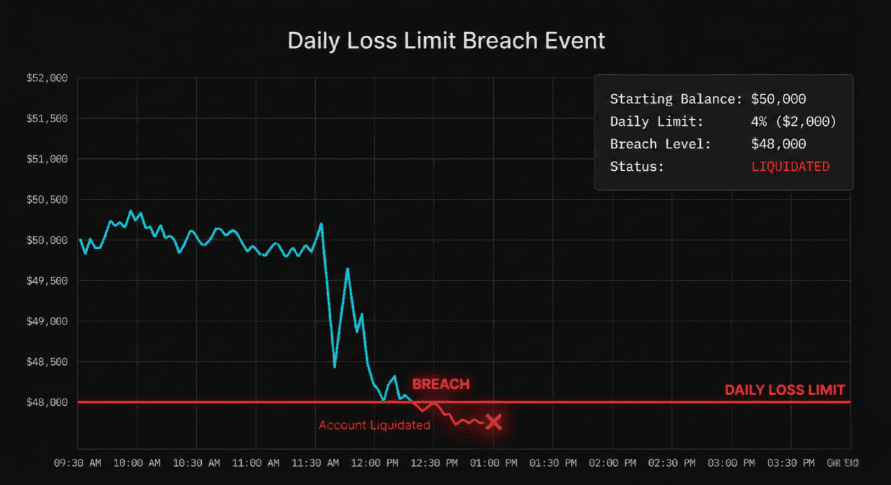
A prop firm daily loss limit is a hard intraday equity threshold that automatically terminates a funded or evaluation account if losses breach it within a single trading session. Firms like FTMO, Topstep, and Apex typically set the cap at 4 to 5 percent of starting balance, measured from the day's opening equity.
In the high-stakes environment of proprietary trading, capital preservation is the primary directive. While profit targets often garner the most attention during evaluation phases, the daily loss limit acts as the true gatekeeper of a funded account. It is the mechanism by which firms manage their exposure and test a trader's professional discipline.
The daily loss limit ~ often referred to as the daily drawdown cap ~ is a hard rule that terminates a trading account if the equity drops below a specific threshold within a single trading session. Unlike the maximum drawdown, which measures the total allowable loss from the account peak, the daily limit focuses strictly on intraday performance.
For prop firms, this rule serves a dual purpose: it protects the firm's capital from catastrophic single-day failures and forces traders to demonstrate consistent risk management. For traders, however, the daily loss limit is the most common point of failure. Firms like FTMO and Topstep both publicly emphasize daily risk parameters as a primary failure mode for evaluation traders. Understanding the mechanics of this rule is not merely a compliance issue; it is a fundamental requirement for long-term viability in the prop trading space.
Identify the Patterns Behind Your Breaches
QuantCyphr's behavioral analysis and daily performance reviews help traders spot the habits that lead to limit breaches ~ before they become account-ending.
Key Takeaways
| Question | Key Answer |
|---|---|
| What is a daily loss limit? | A hard rule that terminates a trading account if equity drops below a specific threshold within a single session ~ also called the daily drawdown cap. |
| How is it calculated? | Daily Limit Amount = Account Balance × Daily Limit %. Remaining Daily Risk (RDR) = Daily Limit Amount − (Realized Loss + Open Floating Loss + Commissions). |
| Typical loss limit % across firms? | Typically 2%~5% of account balance. Several major firms (Topstep, TakeProfit Trader, My Funded Futures) have eliminated daily loss limits in favor of trailing drawdowns. |
| What happens if you breach it? | The account is auto-liquidated and disabled immediately. Evaluations fail and must be reset ~ funded accounts are terminated with accrued profits typically forfeited. |
| How do you stay safely under it? | Set a personal stop at 50%~75% of the firm's limit, use dynamic sizing (reduce by 50% after each loss), cap daily trade count, and use session journaling to catch tilt before it becomes a breach. |
Table of Contents
- 1. How Daily Loss Limits Work
- 2. Common Daily Loss Limit Rules by Firm
- 3. Why Traders Breach the Daily Limit
- 4. How to Calculate and Monitor the Daily Limit
- 5. Strategies to Stay Within the Daily Limit
- 6. How QuantCyphr Helps Prevent Daily Limit Breaches
- 7. What Happens If You Breach the Daily Limit?
- 8. Recovery After a Daily Limit Breach
- 9. FAQ
1. How Daily Loss Limits Work
The daily loss limit functions as an automated circuit breaker. Once the account equity (including unrealized profits and losses) hits the predefined limit, the firm's risk management algorithm liquidates all open positions and disables trading permissions.
The Calculation Mechanism
Typically, firms set the daily loss limit between 2% and 5% of the initial account balance or the starting equity for the day. It is critical to note that most firms calculate this limit based on equity, not balance. This means that open floating losses count toward the limit.
- Static vs. Trailing: A static limit is fixed based on the day's starting balance. A trailing limit moves up as the account equity increases during the day but does not move down if equity drops.
- The "High-Water Mark" Confusion: Some firms calculate the daily limit based on the account's balance at the start of the trading day. Others calculate it based on the highest equity point reached during the day. Traders must clarify which method their chosen firm utilizes.
The Reset Period
Daily limits typically reset at a specific server time, often 5:00 PM ET (market close for Futures). Any losses incurred before this reset time count toward that day's limit. Carrying a losing position through the reset time can result in a breach if the equity drop combined with the previous day's realized loss exceeds the threshold.
Daily Limit vs. Max Drawdown
While the daily limit resets every 24 hours, the maximum drawdown is cumulative.
- Daily Limit: Prevents a trader from blowing up an account in a single session due to tilt or extreme volatility.
- Max Drawdown: Prevents a slow bleed of the account over time.
For example, a trader with a $100,000 account might have a $2,000 (2%) daily loss limit and a $6,000 (6%) max drawdown. Losing $1,500 three days in a row would breach the max drawdown but never the daily limit. Conversely, losing $2,100 in one hour would breach the daily limit, even if the account is still well above the max drawdown floor.
2. Common Daily Loss Limit Rules by Firm
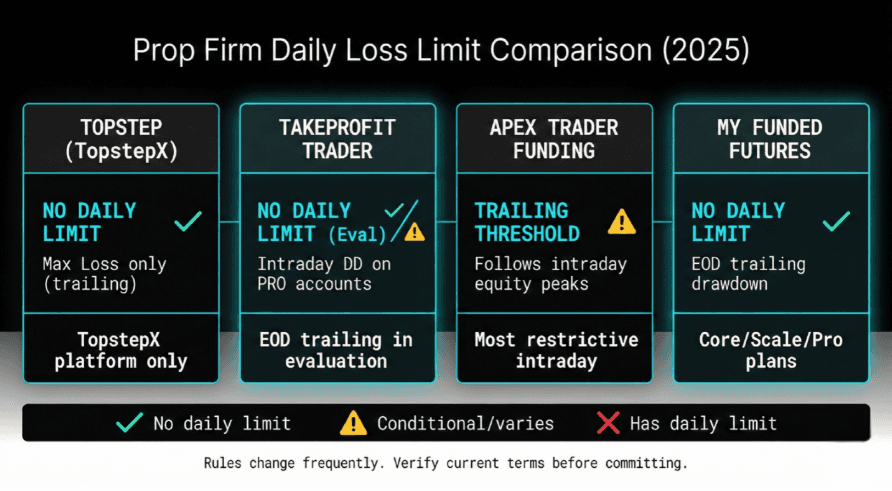
Policies regarding daily loss limits vary significantly across the prop trading landscape. Notably, several major futures prop firms have eliminated traditional daily loss limits in favor of end-of-day trailing drawdowns. Traders must verify current rules before committing to any firm.
TakeProfit Trader (Futures)
As of January 2025, TakeProfit Trader has eliminated the daily loss limit for evaluation accounts. The firm uses an end-of-day trailing drawdown system during evaluations, though PRO (funded) accounts still operate with intraday drawdown monitoring.
- Evaluation Accounts: No daily loss limit; end-of-day trailing drawdown only (tracks highest end-of-day balance)
- PRO Accounts: Intraday drawdown monitoring remains in effect
- Example ($50K account): $2,000 trailing drawdown; if highest EOD balance reaches $51,000, minimum balance becomes $49,000
- Key Advantage: During evaluation, no intraday liquidation risk from daily limits; allows more flexibility during volatile sessions
Topstep (Futures)
Topstep now operates exclusively on the TopstepX platform, which eliminated the daily loss limit as of August 2024.
- Structure: No daily loss limit. Traders are governed by the Maximum Loss Limit (trailing drawdown) only.
- Maximum Loss Limit: $2,000 for a $50K account (trailing, based on highest balance)
- Key Change: Legacy platforms (NinjaTrader, Tradovate) that had daily limits are no longer offered for new accounts.
Apex Trader Funding (Futures)
Apex is known for its trailing drawdown, which acts similarly to a daily limit but is stickier.
- Mechanism: The drawdown trail follows unrealized profits intraday. If a trade goes up $500 and then comes back to break-even, the drawdown limit has effectively tightened by $500. This places a premium on taking profits and avoiding giving back open gains.
Comparative Table of Daily Risk Parameters
| Prop Firm | Daily Loss Limit | Calculation Basis | Intraday Trailing? |
|---|---|---|---|
| Topstep (TopstepX) | None (Max Loss only) | Trailing max drawdown | No |
| TakeProfit Trader | None (eval) / Intraday (PRO) | EOD trailing (eval) / Intraday (PRO) | No (eval) / Yes (PRO) |
| Apex Trader Funding | N/A (Trailing threshold) | Peak intraday equity | Yes |
| My Funded Futures | None (Core/Pro plans) | End-of-day trailing | No (EOD only) |
3. Why Traders Breach the Daily Limit
Despite understanding the mathematical rules, traders frequently breach the daily limit. The root cause is rarely a lack of arithmetic skill; rather, it is behavioral and psychological.
Revenge Trading and the Tilt Spiral
The most common precursor to a daily limit breach is an early session loss. A trader loses 1% of the account in the first hour. Driven by the psychological need to "get back to break-even," they increase position size or take sub-optimal setups. This phenomenon, known as revenge trading, accelerates the equity drop.
Oversizing Positions
Traders often calculate risk based on the total account size rather than the daily limit.
- Incorrect Logic: "I have a $100,000 account, so risking 1% ($1,000) per trade is safe."
- Correct Logic: "I have a $2,000 daily loss limit. Risking $1,000 is risking 50% of my daily capacity on a single trade."
Ignoring Unrealized Losses
A common misconception is that only closed trades count. Most firms monitor real-time equity. A trader holding a position that draws down $2,500 on a $2,000 limit will be liquidated immediately, even if the market eventually reverses and the trade would have been profitable.
Trading Through High-Impact News
Volatility spikes during CPI, NFP, or FOMC releases can cause slippage. A stop-loss order guarantees an exit trigger, not an exit price. In thin liquidity, a stop can be filled significantly lower than anticipated, pushing the loss beyond the daily limit instantly.
Lack of Real-Time Visibility
Many platforms do not display the specific "distance to daily limit" metric prominently. Traders relying on mental math often miscalculate commissions and fees, which are deducted from the daily P&L. A day ending at -$1,950 P&L might actually be -$2,050 once $100 in round-turn commissions are applied, resulting in a breach.
4. How to Calculate and Monitor the Daily Limit
Precision is required to navigate daily limits. Traders must treat the daily limit as the hard "zero" of their account for that session.
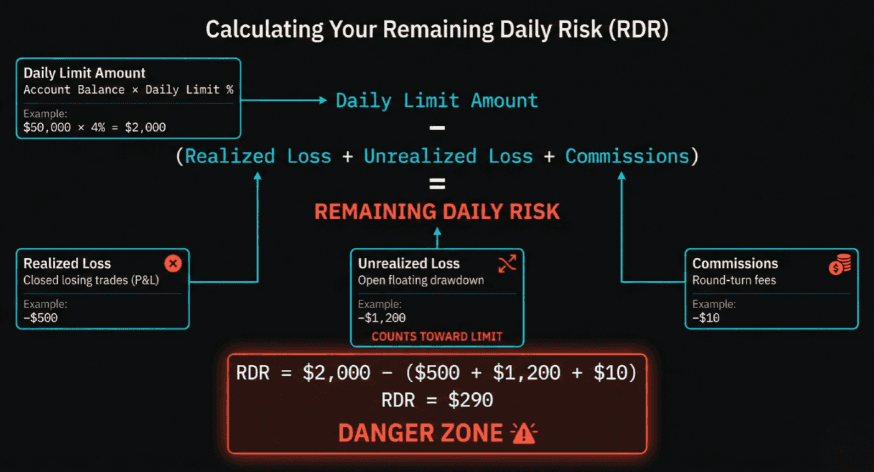
The Formula
To calculate the exact dollar amount available to lose:
The actionable metric is Remaining Daily Risk (RDR):
Example Calculation
Scenario: A trader has a $50,000 account with a 4% daily loss limit ($2,000).
- Start of Day: RDR is $2,000.
- Trade 1: Loses $500 + $10 commission. Realized P&L: -$510. New RDR: $1,490.
- Trade 2 (Open): Currently floating -$1,200.
- Total Equity Drop: $510 (closed) + $1,200 (open) = $1,710.
- RDR: $290.
If the market moves against the open position by another $290, the account is breached.
Real-Time Tracking
Manual calculations during volatile sessions are prone to error. For real-time intraday monitoring, traders should use their platform's built-in risk dashboard (Rithmic, Tradovate, etc.) to track equity relative to their daily limit. For post-session analysis, tools like QuantCyphr help identify the behavioral patterns ~ such as oversizing after early losses ~ that lead to breaches in the first place.
Spot Behavioral Patterns Before They Cost You
QuantCyphr's performance reviews and pattern analysis help identify revenge trading, oversizing, and other habits that lead to daily limit breaches.
5. Strategies to Stay Within the Daily Limit
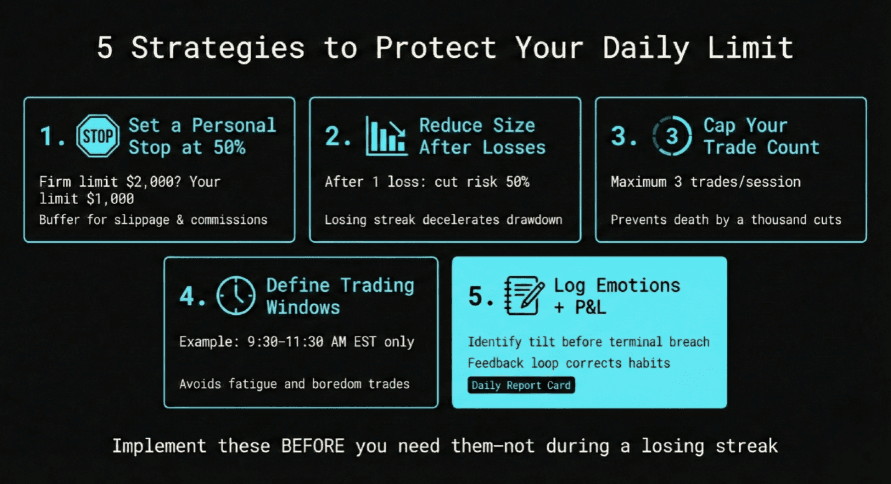
Preventing a breach requires a systematic approach to risk management that is more conservative than the firm's hard rules.
The "Personal Stop" Rule
A best practice is to set a personal daily stop-loss at 50% or 75% of the firm's limit.
- The Buffer: If the firm's limit is $2,000, the trader sets a hard stop at $1,000.
- The Logic: This prevents accidental breaches due to slippage or commissions. It also preserves psychological capital; walking away down 2% is easier to recover from than blowing the account.
Dynamic Position Sizing
Position size should be inversely correlated to recent performance.
- Start of Day: Full risk unit (e.g., 0.5% of account).
- After 1 Loss: Reduce risk unit by 50%.
- After 2 Losses: Stop trading or reduce to micro-lots.
This "risk decay" strategy ensures that a losing streak decelerates the drawdown rather than accelerating it.
Maximum Trades Per Day
Overtrading is a primary driver of daily limit breaches. Setting a cap on the number of trades per session (e.g., max 3 trades) forces the trader to be selective and prevents the "death by a thousand cuts" scenario where small losses accumulate to hit the limit.
Time-Blocking
Fatigue leads to poor decision-making. Traders should define specific operating windows (e.g., 9:30 AM to 11:30 AM EST). Trading outside these windows often yields lower probability setups and higher susceptibility to boredom trades that erode the daily buffer.
Session Journaling
Recording the emotional state and P&L after every trade helps identify "tilt" before it becomes terminal. If a trader notices frustration rising, the correct protocol is to flatten positions and walk away. A structured prop firm trading journal provides the accountability framework needed for consistent risk management.
6. How QuantCyphr Helps Prevent Daily Limit Breaches
Most daily limit breaches stem from behavioral patterns, not calculation errors. QuantCyphr helps traders identify and correct these patterns through cumulative P&L tracking, behavioral analysis, and structured performance reviews.
Cumulative P&L Tracking
QuantCyphr tracks daily P&L cumulatively across trading sessions ~ showing traders their performance trajectory over time. For example, a trader can see that Tuesday was +$400 and Wednesday was +$200, with a cumulative $600 gain. This historical view helps traders understand their consistency and identify which days or conditions lead to losses approaching their limits.
Behavioral Pattern Analysis
The platform analyzes trading behavior to detect patterns that precede breaches. Common patterns include revenge trading after early losses, oversizing positions late in the session, and trading outside optimal hours. By surfacing these patterns, traders can implement corrective rules before the behavior costs them an account.
Monte Carlo Simulations
Understanding the statistical probability of hitting a daily limit is crucial for long-term planning. QuantCyphr's Monte Carlo simulations run thousands of iterations of a trader's historical performance to predict the likelihood of a breach over a given period.
Insight: If the simulation shows elevated breach risk with current behavior patterns, the system surfaces specific adjustments ~ such as reducing position size after early losses or avoiding afternoon sessions ~ to reduce that risk.
Daily Report Card (DRC)
The Daily Report Card enforces accountability. By requiring a structured review of the session ~ facilitated by 5-minute voice transcription ~ traders must confront their near-misses and behavioral lapses. This feedback loop corrects the habits that lead to limit breaches, such as holding losers too long or averaging down.
7. What Happens If You Breach the Daily Limit?
The consequences of a breach depend on the specific firm and the phase of the trader's journey.
Immediate Suspension
In almost all cases, the breach triggers an automatic liquidation. The trading platform will lock the account, preventing further order entry.
Evaluation Phase
- Result: The evaluation is failed. The account is usually disabled.
- Recourse: The trader must pay for a "reset" or purchase a new evaluation to try again. The progress made (profits accumulated) is lost.
Funded Phase
- Result: This is more severe. The funded account is terminated. Any accrued profits that have not yet been withdrawn are typically forfeited.
- Recourse: The trader loses their professional status with the firm and must return to the evaluation phase to requalify.
Soft Breach Policies
Some firms distinguish between "hard breaches" (max drawdown) and "soft breaches" (daily limit). A soft breach may close open trades and disable the account for the rest of the day but allow the trader to resume the next day without terminating the account. This is rare and usually reserved for specific account types. Traders should not assume a soft breach policy exists unless explicitly stated in the Terms of Service.
8. Recovery After a Daily Limit Breach
Experiencing a breach is a significant psychological blow. The recovery process must be strategic to prevent a cycle of failures.
1. Data Review
Before purchasing a new evaluation, the trader must analyze the breach. Was it a technical error, a misunderstanding of the rules, or an emotional collapse?
Action: Use the Daily Report Card to review the specific trade sequence. Did the breach occur on one large trade (risk management failure) or a series of ten trades (overtrading)?
2. Sizing Calibration
If the breach occurred due to normal market volatility stopping out positions, the position sizing was too aggressive.
Action: Reduce position sizing by 50% for the next attempt. Focus on survival metrics rather than profit targets.
3. Implementing Hard Stops
Technical solutions are superior to willpower.
Action: Use platform settings (e.g., Rithmic Trader Dashboard or Tradovate Risk Settings) to set a max daily loss limit at the broker level that is tighter than the prop firm's limit. If the firm's limit is $2,000, set the broker auto-liquidate at $1,500.
4. Psychological Reset
Attempting a new challenge immediately after a breach often leads to "rushing."
Action: Take a 48-hour break from live markets. Engage in simulation or backtesting to restore confidence in the strategy without financial pressure.
9. Frequently Asked Questions
What is a prop firm daily loss limit?▼
The daily loss limit is the maximum amount a trader is permitted to lose in a single trading day. If the account equity drops by this amount from the start-of-day balance, the account is automatically liquidated and often terminated.
Does the daily loss limit include unrealized losses?▼
Yes. Most major prop firms calculate the daily loss limit based on equity, not closed balance. This means if an open trade draws down below the limit, the account will be breached even if the trade is not closed.
What happens if I breach the daily loss limit?▼
In an evaluation account, the challenge is failed, and a reset or new purchase is required. In a funded account, the account is typically terminated, and the contract is voided.
How do I track my daily P&L in real-time?▼
Traders can use their trading platform's dashboard (e.g., Rithmic, Tradovate) for real-time monitoring. Tools like QuantCyphr's Daily Report Card help with cumulative P&L tracking and behavioral analysis to identify patterns that lead to breaches.
Can I trade again after breaching the daily limit?▼
Generally, no. A breach usually results in the disabling of the account. To trade again, one must purchase a new evaluation or pay a reset fee, depending on the firm's rules.
What's the difference between daily limit and max drawdown?▼
The daily limit resets every 24 hours and caps losses for a single day. The max drawdown is a cumulative limit on the total loss from the account's peak balance (or starting balance) over the lifetime of the account.
Which prop firms have the most lenient daily limits?▼
Several futures prop firms like TakeProfit Trader and My Funded Futures have eliminated daily loss limits entirely as of 2025, using end-of-day trailing drawdowns instead. Always verify current terms as firm rules change frequently.
How can I prevent revenge trading after early losses?▼
To prevent revenge trading, implement strict rules such as a max trades per day cap or a circuit breaker rule where trading stops after losing 50% of the daily limit. Using a trading journal like QuantCyphr's Daily Report Card helps identify and correct these behavioral patterns.
Conclusion
The daily loss limit is the defining constraint of the prop trading industry. It is not merely a hurdle to be cleared but a permanent parameter of professional risk management. Traders who view the daily limit as an adversary often fail; those who respect it as a protective guardrail survive.
Success in proprietary trading is not defined by the ability to generate massive returns in a single day, but by the ability to avoid the single day that erases weeks of progress. By understanding the nuances of how limits are calculated, employing real-time monitoring tools, and strictly adhering to personal risk buffers, traders can navigate these constraints effectively.
Platforms like QuantCyphr provide the necessary infrastructure to professionalize this process. Through cumulative P&L tracking, predictive modeling, and accountability journals, traders can shift their focus from fearing the limit to mastering their performance.
Protect Your Funded Account
The Risk Terminal, Funding Optimizer, and Daily Report Card work together to prevent breaches before they happen. Master your risk with QuantCyphr.
Related Articles
- The Complete Prop Firm Trading Guide: Rules, Risks, and How to Pass Evaluations
- Apex Trader Funding Review 2026: Is the Intraday Trailing Drawdown Worth the Risk?
- The Ultimate Trading Journal Guide: From Manual Logs to AI-Powered DRCs
- The Complete Trading Psychology Guide: Master Emotions, Biases, and Discipline
- Why Most Traders Give Up (And How To Prevent It)